
The 10-Shot Range Game That Transfers To The Course
If your idea of practising your irons is dragging ball after ball onto a rubber mat and mindlessly slapping them down the range, you are wasting your time and your money. I was out on the range recently with one of my clients, William, running him through a simple approach-shot game that actually transfers to the golf course.
Most golfers rock up to the range and practise hitting golf balls. That is not the same as practising golf. On the course, when you have an iron or a wedge in your hand, you are trying to land the ball on a green with a left edge, a right edge, and usually a nasty bunker guarding the front. You have to make decent contact, and you have to solve the problem in front of you.
Here is the exact game I gave William to turn useless range time into lower scores.
THE 10-BALL IMAGINARY GREEN GAME
Forget hitting 50 wedges in a row. You only need 10 balls for this, and it is going to feel much harder than your normal range session.
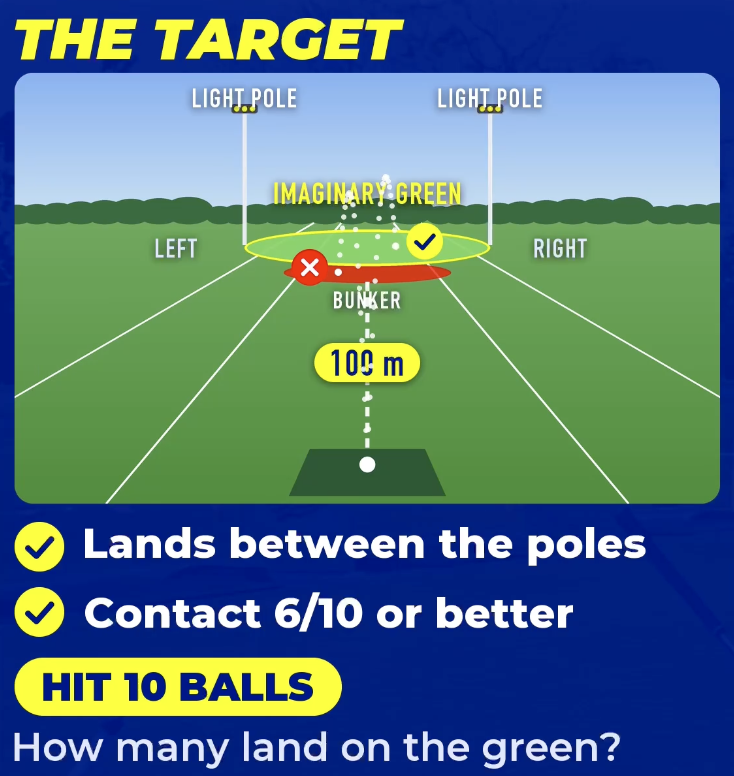
Pick a realistic approach distance, such as 100 metres (109 yards).
Look down the range and pick two targets, like two light poles, to act as the left and right edges of your imaginary green.
Set the standard: the ball must finish between those two poles, and your contact has to be a 6 out of 10 or better so it would actually carry an imaginary front bunker.
Go through your full pre-shot routine on every single ball. Step back behind the ball, read the wind, pick your aim point, line the clubface up first, take your grip and ball position, look at the target, and swing.
Keep score out of 10.
If you do not step back behind the ball after every shot, you are cheating yourself. We are not trying to get into a mindless rhythm. We are training the skill of stepping up cold and landing a ball on a green, just like you have to do on Saturday morning.
BUILDING REAL EVIDENCE
When I stepped up to demonstrate for William, the wind was blowing left to right, so I aimed a touch left, ran through my routine, and landed it on the left side of the imaginary green with solid contact. Happy days.
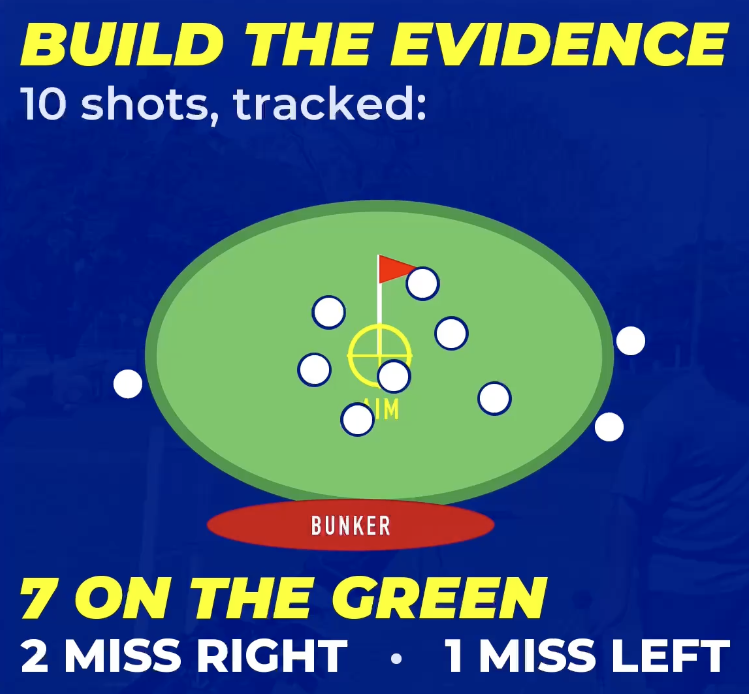
Now, the point of doing this 10 times, and eventually 100 times, is to build real evidence about your shotgun dispersion pattern.
If you play this game and see that you hit 7 out of 10 greens, with two misses going right and one going left, you have gold in your hands. Once you have that evidence over 100 shots, you can walk onto the golf course knowing that if you aim slightly down the left side of every green, you might start hitting 8 or 9 out of 10. That is how you play scoring golf instead of guessing.
HOW TO SELF-COACH LIKE WILLIAM
This game is also brilliant because it teaches you to become your own coach using the review phase of my R.E.P.A.R. system.
When William stepped up for his first go, he missed the imaginary green. Instead of letting him just rake another ball over and swing again, I asked him to review it:
What happened with the contact? William nailed it straight away: he hit the ground just before the ball.
What will you do differently next time? When you hit it heavy, the ball is usually too far forward in your stance, or you are hanging back on your trail side. William knew it was a bit of both.
So for the next shot, he stepped back, adjusted his ball position slightly further back, and focused on finishing his weight all the way through to his lead side.
Result? Much better contact. Did it hit the green? No, it went out to the right.
So we reviewed again. William guessed it was his aim, which is where having a coach's eyes helps. His aim was actually dead straight, but his clubface was pointing right at impact. I also spotted that he snuck in two practice swings instead of one, which creeps in when you are under a bit of pressure.
EMBRACE BEING TERRIBLE AT IT
I told William the exact same thing I am going to tell you: when you first play this game, you are going to be terrible at it.
Good. That is fantastic news.
If your practice feels easy, you are not getting better. Walking away thinking you are pretty bad at this game simply means you have massive room for improvement, and you are finally training in a way that matches the chaos of the golf course.
Stick to the steps, track your misses, and ask the right questions after every shot. Before you know it, you will be self-coaching your way to more greens and lower scores.
Book your Play With The Pro Experience and let's find out what's really costing you shots.
Watch the full video here:
https://youtu.be/Vtc5ufG1dhY
-
Pick a target distance such as 100 metres (109 yards) and choose two landmarks on the range to act as the left and right edges of a green.
Hit 10 balls using your full pre-shot routine on every shot, and count how many finish between the targets with solid contact of 6 out of 10 or better.
-
Stepping back forces you to reset your alignment, assess the wind, and repeat your pre-shot routine.
This mirrors real on-course conditions and prevents you from falling into a mindless driving range rhythm that never transfers to the golf course.
-
Ask yourself what happened with your contact or clubface, why the ball missed where it did, and what one small adjustment you will try on the next shot.
This builds your ability to self-coach under pressure.
