
What Should I Do on the Putting Green Before a Round?
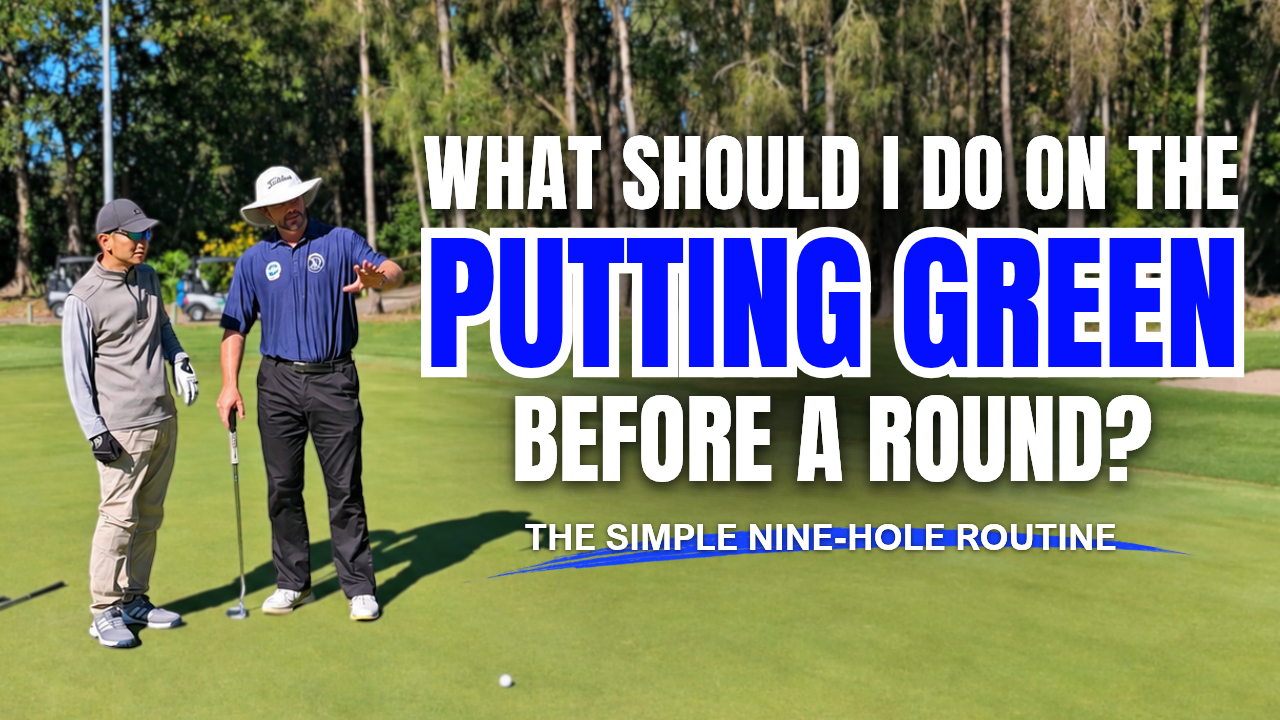
Before a round, don't just hit a few putts and hope you get a feel for the greens. Use one ball and play nine different putting holes, going through the same read, plan, execution and review process you'll use on the golf course.
The goal isn't simply to see whether you can hole a few putts.
You're trying to get a feel for the greens and train your brain to read, plan and execute putts when there is actually something at stake.
That's very different from throwing three balls down beside a hole and hitting them one after another.
Here's how I want you to prepare.
Why Most Pre-Round Putting Practice Is a Waste of Time
This is what I see golfers doing all the time.
They come off the buggy, grab three balls and throw them down beside a hole.
They hit one.
Then they hit another from exactly the same spot.
Then another.
Maybe one goes in.
Maybe one misses left.
Maybe another misses right.
Then they move somewhere else and do the same thing again.
It looks like putting practice.
But there's a problem.
On the golf course, you never get to hit two putts from exactly the same spot.
Every putt requires you to read the green, work out what you think is going to happen, choose where you want to start the ball and decide how hard you need to hit it.
That's what you need to practise.
Your First Put Is the One That Actually Matters
Think about those three balls you've just hit from the same place.
The first putt is the one where you've actually had to:
Read the green
Work out the break
Decide where to aim
Decide how far the ball needs to travel
Make the stroke
The next two are different.
You've already got information from the first putt.
You know what happened.
You've seen the break.
You've seen the speed.
You've got another couple of chances to adjust.
That's not what happens when you're playing.
You get one putt.
So I want your practice to look much more like the game you're actually preparing for.
Start With a Read
When Brian and I do this exercise, the first thing he has to do is read the green.
Don't just walk up to the ball and hit it.
Get behind it.
Look at the putt.
Ask yourself:
"What do I think is going to happen after I hit it?"
That's the first part of your routine.
You're trying to understand the break and the speed before you make your decision.
You're not trying to guarantee that you get the read right.
You're training yourself to make a read and make a decision.
Then Make Your Plan
Once you've read the putt, you need to make your plan.
There are two simple questions I want you to answer:
Where do I need to aim?
And:
How big a swing do I need to make to hit it that far?
Now you've got a complete plan.
You've read the green.
You've chosen your starting line.
You've worked out the distance.
Now it's time to execute.
Hit One Ball
This is where the practice starts to become much more like golf.
Hit one ball.
That's it.
Don't hit another two from the same place.
Don't immediately have another go because you didn't like the first one.
You've made your read.
You've made your plan.
Now you've got one opportunity to execute it.
That's exactly what happens on the golf course.
Play Nine Different Putting Holes
Once you've hit the first putt, go to another hole.
Then another.
And another.
I want you to do this nine times.
You can think of it as playing nine holes of golf — except you're playing them on the putting green.
You've got:
One ball
Nine different holes
A read
A plan
One attempt
A score
Now you've created a game.
And games have rules.
More importantly, games have consequences.
Give Yourself a Score
The next part is simple.
Keep score.
You're trying to see how low you can score over your nine putting holes.
Now there's actually something on the line.
You aren't just wandering around the putting green hitting balls.
You've created a little game.
And that's important because your brain behaves differently when there is a consequence to the shot.
Why Consequence Matters
This is one of the biggest differences between practising golf and actually playing golf.
If you miss a putt during casual practice, what happens?
You pick up the ball and hit another one.
No big deal.
But if you miss that same putt on the golf course, you have to deal with it.
You might be annoyed.
You might be disappointed.
You might have to hole the next one to save your score.
That's part of golf.
So if you want your practice to prepare you for playing, there needs to be some consequence.
When Brian missed one of the short putts during this exercise, he wasn't particularly happy about it.
And that's actually useful.
Because that's how the game is supposed to feel.
Don't Walk Away After a Miss
This is another important part of the exercise.
When you miss a putt, you don't just pick up your ball and forget about it.
You have to go through the routine again.
Read it.
Make your plan.
Aim.
Decide how much stroke you need.
Then hit it.
That's exactly what you'll have to do on the golf course.
You're not practising how to avoid missing putts.
You're practising what to do when you miss one.
That's a very different skill.
You're Training More Than Your Putting Stroke
The reason I like this exercise is that you're not just training your ability to hit a golf ball.
You're training a process.
Read it.
Plan it.
Do it.
Review it.
Then do it again.
That's what you're going to have to do on the golf course.
And that's why simply rolling three balls towards a hole doesn't give you the same training.
You're practising the stroke, but you're not necessarily practising the decision-making process that comes before it.
You're Also Getting a Feel for the Greens
There's another benefit.
By the time you've played your nine putting holes, you've spent some time learning what the greens are doing that day.
You start to get a feel for:
How fast the greens are
How much they break
How much pace you're going to need
How the ball reacts when you miss your intended line
So when you walk onto the first green, you've already done some useful work.
You haven't just hit some putts.
You've actually played the greens.
The Pre-Round Putting Game
Here's the routine I'd like you to try before your next round.
1. Take one ball
Don't take three.
One ball forces you to treat each putt as an individual shot.
2. Pick a hole
Start somewhere on the putting green.
3. Read the putt
Get behind the ball and work out what you think is going to happen.
4. Make your plan
Decide:
Where do I need to aim?
How big a swing do I need to make?
5. Hit one putt
One ball.
One attempt.
6. Go to another hole
Don't hit another putt from the same spot.
7. Keep score
Do this for nine different holes.
Now you're playing a game.
8. Repeat the routine
Every putt gets the same process:
Read → Plan → Do → Review.
That's what I want you training.
The Simple Version
If you've only got a few minutes before your next round, don't waste them mindlessly hitting three balls around the same hole.
Take one ball.
Pick nine different holes.
For every putt:
Read the green.
Work out what you think will happen.
Choose where to aim.
Decide how much stroke you need.
Hit one ball.
Review what happened.
Then move to the next hole.
Now you're not just warming up your putting stroke.
You're training your brain to play golf.
And that's a much better way to prepare for what you're about to do on the course.
Want to Get Better at More Than Just Putting?
This is one of the biggest differences between practising golf and actually learning how to play it.
You don't just need to hit better golf shots.
You need to learn how to read, plan, make decisions, execute and deal with the result.
That's why so much of my coaching happens on the golf course.
I want to see what actually happens when you're playing rather than simply watching you hit balls on a range.
If you're not sure what's really costing you shots, book a Play With The Pro Experience and let's work it out.
Watch the Original Video
In the video below, I take Brian through this putting exercise so you can see exactly how I want you to practise before you play.
-
The Gold Coast offers a range of options including Emerald Lakes, Palm Meadows, Hope Island, Southport, and Coolangatta-Tweed. Paul Williamson provides personalised on-course coaching that goes beyond traditional lessons, covering skills, strategy, and mental game in real playing conditions.
-
One-hour lessons provide quick tips but rarely translate under course conditions. Paul’s on-course coaching uses 9-hole assessments to build a tailored plan that actually drops strokes from your scorecard.
-
Paul Williamson, a PGA Professional with 30+ years’ experience, provides personalised on-course coaching at courses around Carrara, Hope Island, Robina, Southport, Coolangatta-Tweed, and the broader Gold Coast.
